88% of online consumers won’t return to a website after a bad experience. Every day, businesses lose thousands of potential customers simply because their websites can’t engage visitors quickly enough. With 40% of people abandoning websites that take more than 3 seconds to load, and 60% of shoppers leaving purchases due to poor website experiences, the cost is staggering. Slow-loading websites alone cost retailers $2.6 billion in lost sales annually.
The AI automation funnel changes this equation entirely. By replacing static forms with intelligent chatbots that engage visitors instantly, businesses are converting browsers into buyers at unprecedented rates. Websites using AI chatbots experience a 23% increase in conversion rates, while traditional forms average just 1.7% conversion rates. This article shows you exactly how to build an AI automation funnel that transforms your website from a digital brochure into a revenue-generating machine.
Why Traditional Website Forms Aren’t Enough
Your website has seconds to make an impact. Users form opinions about websites in just 50 milliseconds, and traditional forms are failing this critical first test. Here’s the harsh reality:
- Massive abandonment rates: Over 81% of people have abandoned at least one web form
- Zero engagement: Forms sit passively while competitors actively court your visitors
- Mobile friction: Conversion rates are 1.7 times higher on desktops than smartphones because forms aren’t optimized
- Delayed responses: Hours of waiting send prospects directly to competitors
- Poor user experience: 38% of people stop engaging if content or layout is unattractive
AI chatbots for lead generation eliminate these pain points completely. Chatbot leads convert at three times the rate of traditional sign-up forms because they provide instant, personalized interactions. Unlike forms that collect data passively, chatbot marketing automation qualifies leads through intelligent conversations that adapt based on user responses and behavior patterns.
The Complete AI Automation Funnel Explained
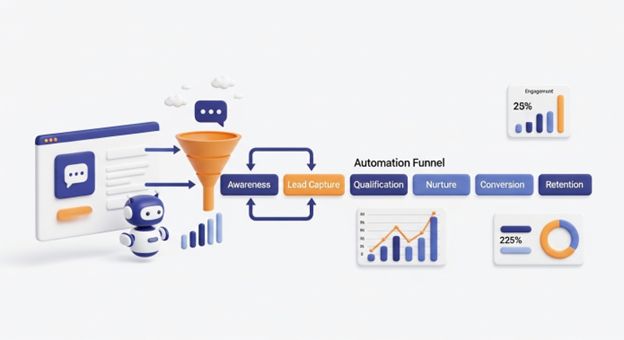
An effective AI automation funnel operates across six interconnected stages that guide visitors from awareness to loyal customers:
Stage 1: Awareness – Chatbots greet visitors with personalized messages based on traffic source, location, or browsing behavior. Context-aware greetings immediately establish relevance and capture attention.
Stage 2: Lead Capture – Conversational interfaces collect contact information naturally through dialogue, not intimidating 10-field forms. Progressive profiling spreads data collection across multiple interactions.
Stage 3: Qualification – Intelligent question flows score leads based on budget, timeline, authority, and need. High-value prospects get routed to sales teams in real-time while others enter nurture sequences.
Stage 4: Nurture – Automated sequences deliver targeted content across email, chat, and retargeting. The system tracks engagement and adjusts messaging based on behavior signals.
Stage 5: Conversion – Chatbots assist with product selection, answer objections, clarify pricing, and facilitate transactions directly within conversations. Real-time support during checkout reduces abandonment.
Stage 6: Retention – Post-purchase, AI chatbot lead nurturing strategies deliver onboarding assistance, cross-sell opportunities, and proactive support that transforms one-time buyers into repeat customers.
This systematic approach to automated lead qualification ensures every prospect receives appropriate attention while maximizing sales team efficiency.
How AI Chatbots Fit Into Each Funnel Stage
Awareness & Engagement
Conversational AI in marketing transforms first impressions by:
- Delivering context-aware greetings that reference the visitor’s current page
- Offering proactive assistance before users formulate questions
- Suggesting personalized content based on browsing patterns
- Providing instant FAQ responses that reduce bounce rates
Research shows that 69% of customers appreciate chatbots because of how quickly they can connect with a company. This immediate engagement creates positive experiences that traditional websites can’t match.
Lead Capture & Qualification
Advanced AI sales funnel automation tools capture qualified leads through natural conversation:
- Build rapport before requesting contact information
- Collect data progressively across multiple interactions
- Score leads in real-time based on responses
- Route high-intent prospects to sales teams instantly
Businesses utilizing conversational marketing technology report a 36% higher conversion rate compared to those relying on forms alone. This approach to automated customer engagement with AI chatbots dramatically improves lead quality.
Nurture & Follow-up
CRM integration enables powerful automation:
- Synchronize conversations with contact records automatically
- Trigger email sequences and retargeting campaigns based on chat interactions
- Update lead scores continuously as engagement evolves
- Personalize messaging that adapts to behavioral patterns
When leads show interest but don’t convert immediately, AI sales funnel automation maintains engagement without human intervention.
Conversion & Upsell
At critical purchase moments, chatbots provide:
- Product recommendations based on browsing history and stated needs
- Real-time objection handling and pricing clarification
- In-chat transaction processing that reduces friction
- Checkout assistance that prevents last-minute abandonment
In specific industries like retail and finance, chatbots achieve conversion rates as high as 70%, demonstrating the technology’s power when properly implemented.
Retention & Re-engagement
A well-implemented website chatbot for conversions delivers ongoing value:
- Onboarding assistance and product usage guidance
- Personalized cross-sell and upsell opportunities
- Proactive customer support without overwhelming human teams
- Loyalty program engagement and exclusive offers
Real-World Performance Data
Industry Benchmarks
Business leaders report a 67% increase in sales through chatbot interactions. Performance varies by implementation quality and industry vertical:
E-commerce Results:
- Significant cart abandonment reduction
- Average order value increases through intelligent recommendations
- Customer support ticket volume decreases of 50%+
- ROI improvements within six months of implementation
SaaS Outcomes:
- Qualified demo booking increases
- Response time improvements from hours to seconds
- Lead-to-demo conversion rate gains
- Cost per qualified lead reductions
Service Industry Success:
- Initial consultation automation
- Conversion rate improvements versus traditional forms
- Customer acquisition cost reductions
- Streamlined support operations
Studies demonstrate that AI chatbots resolve customer issues 18% faster with a 71% success rate in resolving queries. This combination of speed and effectiveness proves the technology’s value beyond simple automation.
The data validates using AI chatbots to turn visitors into customers when implementations include proper qualification logic, CRM integration, and optimization processes.
Advanced AI Features Driving Success
Modern AI-powered customer service leverages sophisticated technology:
Natural Language Processing (NLP):
- Interprets complex questions with human-like accuracy
- Maintains context across extended conversations spanning days
- Handles multiple topics within single interactions seamlessly
Predictive Lead Scoring:
- Analyzes behavioral signals including time on site, pages visited, and downloads
- Prioritizes high-intent prospects for immediate human outreach
- Refines scoring continuously based on conversion data
Sentiment Analysis:
- Detects customer frustration in real-time
- Escalates to human agents before abandonment occurs
- Adjusts tone and approach based on emotional cues
Machine Learning:
- Improves response accuracy over time automatically
- Identifies successful conversation patterns
- Optimizes question flows for better conversions
These chatbot engagement strategies separate effective implementations from basic FAQ bots. Average chatbots generate 35-40% response rates, while better-designed chatbots with engaged customers generate up to 90% response rates.
Integration With Marketing Stack
The true power of digital marketing automation with chatbots emerges through seamless integration:
CRM Platforms (HubSpot, Salesforce, Marketo):
- Synchronize conversations with contact records
- Create unified customer profiles across touchpoints
- Enable comprehensive journey tracking
Email Automation Tools:
- Trigger sequences based on specific chat interactions
- Maintain consistent messaging across all channels
- Track multi-touch attribution accurately
Analytics Platforms:
- Measure chatbot contribution to revenue precisely
- Identify optimization opportunities through data analysis
- Monitor performance metrics in real-time
Retargeting Systems:
- Target visitors who engaged but didn’t convert
- Reference previous conversations in ad messaging
- Create cohesive multi-channel experiences
Understanding live chat automation tips enhances implementation success across your entire marketing stack.
Best Practices for AI Chatbots in Sales Funnels
Successful implementations follow proven principles:
Design Natural Conversations:
- Mirror human dialogue patterns without robotic scripts
- Use casual language appropriate to your brand voice
- Avoid overwhelming users with too many questions upfront
Implement Progressive Profiling:
- Collect information across multiple interactions
- Build trust before requesting sensitive data
- Create value before asking for anything in return
Provide Clear Escalation Paths:
- Identify chatbot as AI-powered upfront transparently
- Offer human agent handoff when appropriate
- Set appropriate capability expectations clearly
Test and Optimize Continuously:
- Launch with extensive conversation flow testing
- Monitor weekly performance metrics religiously
- Analyze drop-off points and optimize systematically
Balance Automation with Personalization:
- Use visitor data thoughtfully, not invasively
- Deliver immediate value, not just data collection
- Respect privacy while providing relevant experiences
For e-commerce businesses, AI sales chatbots for e-commerce provide specialized strategies for product discovery and purchase acceleration.
Conclusion
The AI automation funnel powered by intelligent chatbots fundamentally changes how businesses convert website visitors into paying customers. With 88% of consumers refusing to return after bad experiences, you can’t afford passive engagement strategies.
Key Implementation Takeaways:
- Deploy chatbots that engage visitors within seconds, not hours
- Implement progressive qualification that feels like helpful conversation
- Integrate with CRM and marketing tools for unified customer profiles
- Optimize continuously based on performance data, not assumptions
Organizations implementing strategic AI chatbots for customer conversion gain compounding advantages: faster response times, superior lead qualification, higher conversion rates, and improved customer lifetime value.
Your Action Plan:
- Audit your current funnel and identify engagement bottlenecks
- Calculate the cost of your current visitor abandonment rates
- Select technology partners with proven integration capabilities
- Launch with clear success metrics and optimization plans
The competitive advantage belongs to businesses that act now. Evaluate where AI chatbots for lead generation can eliminate friction in your funnel and start converting the traffic you’re already paying for into measurable revenue growth.

Tina Layton is an AI expert and author at ChatGPT Global, specializing in AI-driven content creation and automation. With a background in machine learning and digital marketing, she simplifies complex AI concepts for businesses and creators. Passionate about the future of AI, Tina explores its impact on content, automation, and innovation.
Leave a Reply